Savusavu Weather and Best Time to Visit
Last fact-checked:
Savusavu is warm throughout the year, but June through September is the clearest choice for travelers prioritizing lower rainfall and cooler temperatures. The official 1991-2020 climate normals for Savusavu Airfield show July as the driest month, with 75.1 mm of rain, and August as the coolest, with an average high of 27.1°C and average low of 21.4°C.
November through April is warmer and wetter. January has the highest average rainfall, while February has the highest average daytime temperature. Rain can still fall in the drier months, and wind or rough seas can affect boat trips even when the land forecast looks fine. The best month therefore depends on whether your priority is hiking, diving, warmer water or the lowest chance of prolonged wet weather.
Warm Year-Round • Driest in July • Wet Season November to April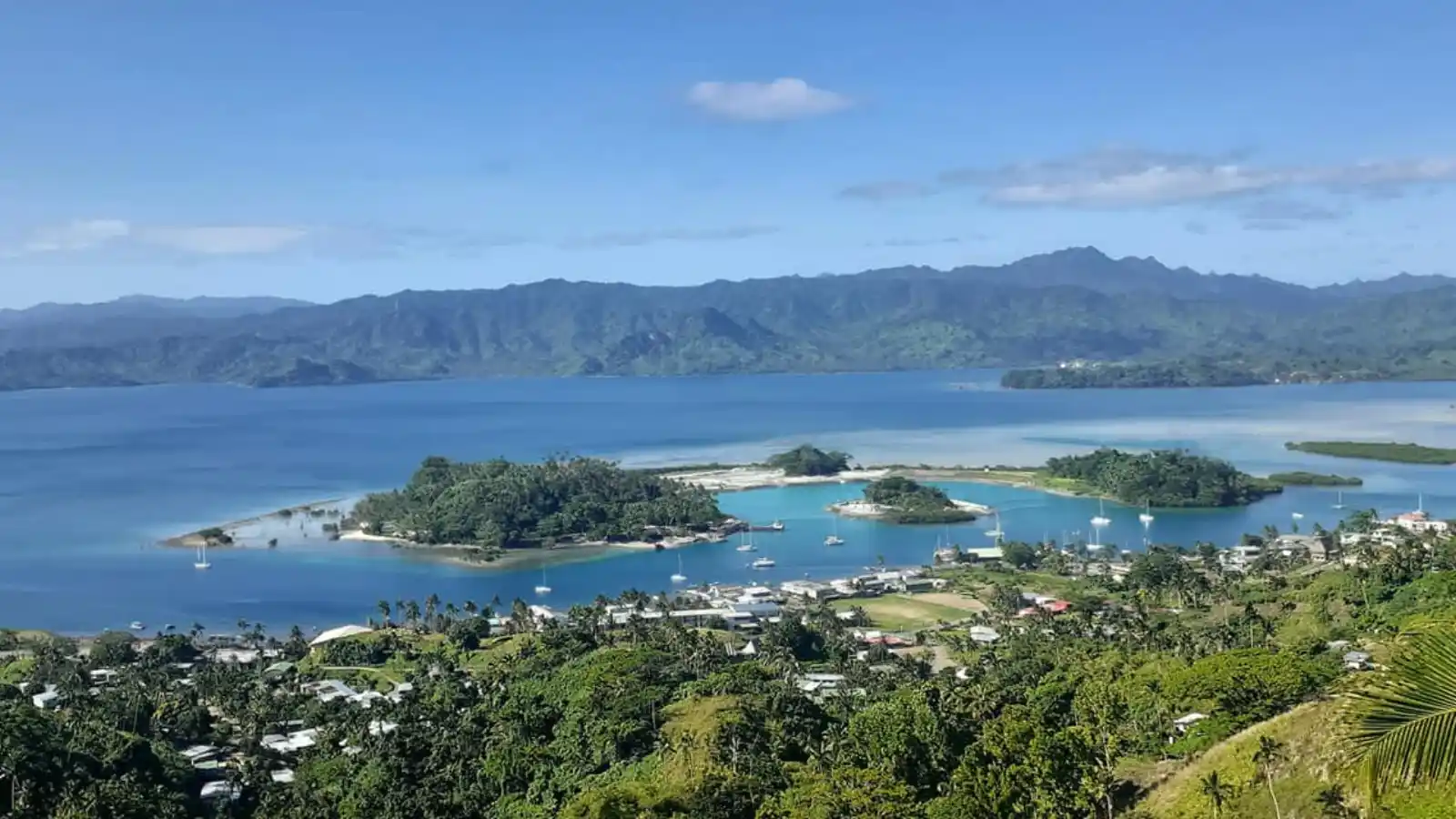
| Quick fact | What travelers should know |
|---|---|
| Best drier window | June through September |
| Driest month | July, averaging 75.1 mm of rain |
| Warmest period | January through March, with average highs around 30.6°C to 30.9°C |
| Coolest period | July and August, with average lows around 21.4°C to 21.5°C |
| Wet season | November through April, with higher humidity and cyclone awareness required |
| Typical sea temperature | About 25°C to 27°C in the cooler months and 28°C to 29°C in the warmer months |
| Live forecast | Use the Fiji Met public forecast for current Savusavu conditions |
Savusavu weather by month
The table below uses Fiji Meteorological Service climate normals for Savusavu Airfield covering 1991-2020. These are long-term averages, not a forecast for a particular holiday. A monthly rainfall total also does not show whether rain fell in short bursts or across several unsettled days.
| Month | Average high | Average low | Average rainfall | Practical reading |
|---|---|---|---|---|
| January | 30.6°C / 87°F | 23.7°C / 75°F | 284.6 mm / 11.2 in | Warm, humid and the highest monthly rainfall average |
| February | 30.9°C / 88°F | 23.9°C / 75°F | 219.5 mm / 8.6 in | Highest average daytime temperature |
| March | 30.8°C / 87°F | 23.9°C / 75°F | 212.6 mm / 8.4 in | Hot wet-season conditions remain |
| April | 30.0°C / 86°F | 23.7°C / 75°F | 207.0 mm / 8.1 in | Transition begins, but rainfall remains relatively high |
| May | 28.7°C / 84°F | 22.8°C / 73°F | 162.0 mm / 6.4 in | Noticeably cooler and drier than April |
| June | 27.9°C / 82°F | 22.2°C / 72°F | 122.8 mm / 4.8 in | Useful balance of lower rainfall and mild nights |
| July | 27.2°C / 81°F | 21.5°C / 71°F | 75.1 mm / 3.0 in | Driest month in the official normals |
| August | 27.1°C / 81°F | 21.4°C / 71°F | 101.1 mm / 4.0 in | Coolest average high and low |
| September | 27.6°C / 82°F | 21.8°C / 71°F | 113.2 mm / 4.5 in | Still relatively dry as temperatures begin rising |
| October | 28.2°C / 83°F | 22.4°C / 72°F | 173.9 mm / 6.8 in | Warmer transition month with increasing rainfall |
| November | 29.2°C / 85°F | 23.0°C / 73°F | 181.2 mm / 7.1 in | Warmer, more humid and entering wet season |
| December | 30.1°C / 86°F | 23.6°C / 74°F | 198.4 mm / 7.8 in | Warm wet-season conditions |
The station sits at Savusavu Airfield. Rainfall and temperature can differ around the bay, on exposed coasts and at higher elevations, so use these numbers as a planning baseline rather than a promise for every part of the region.
Dry season in Savusavu: May through October
May through October is cooler and generally drier, but the strongest lower-rainfall window in the Savusavu normals is June through September. July is the driest month, while August has the lowest average high and low. May and October are transition months and receive substantially more rain than July.
These temperatures are comfortable for walking and hiking, especially compared with the warmer wet season. A light layer can be useful for early starts, evening boat rides and air-conditioned transfers. The drier months are also a sensible starting point for the Waisali Rainforest Reserve, although recent rain can still leave forest paths muddy.
Do not assume that dry season means flat seas. Southeasterly winds can strengthen and exposed water can become rough. If snorkeling at Lesiaceva Point, choose the day from the current forecast and local conditions rather than the calendar alone.
Wet season in Savusavu: November through April
November through April is warmer, more humid and wetter. The Savusavu Airfield normals place January highest for rainfall at 284.6 mm, followed by February, March and April above 200 mm. February has the highest average daytime temperature at 30.9°C. These are monthly averages, so one trip may have several usable days while another catches a slow-moving trough or a period of heavier rain.
A wet-season itinerary works best with flexibility. Place weather-dependent boat trips early in the stay, avoid scheduling a separate non-refundable activity for every day and keep one or two town or resort options available. The waterfront Savusavu Hot Springs can fit into a shorter town visit when conditions change, while the Savusavu local transport guide helps with taxis, rental cars and longer trips around Vanua Levu.
Rain does not automatically cancel a day, but avoid relying on a fixed pattern such as clear mornings followed by a brief afternoon shower. Tropical rain can arrive at different times and may last longer when a larger weather system is nearby.
Choose the best months for your trip
| Priority | Useful starting window | Why |
|---|---|---|
| Lowest average rainfall | June through September | These four months have the lowest rainfall totals in the official normals |
| Cooler hiking weather | July through September | Average highs remain around 27°C to 28°C, with cooler nights |
| Warmer sea temperatures | November through April | Local operator guidance places warmer-season water around 28°C to 29°C |
| Clearer-water diving | Start with July through October | Cooler-season visibility is often better, but the exact site and daily sea conditions matter more than the month alone |
| A transition-month trip | May or October | Temperatures are moderate, but rainfall is higher than in the June to September window |
If weather reliability is the main decision, July has the strongest statistical case. If slightly warmer temperatures matter more, September offers a useful compromise while remaining relatively dry in the long-term record. Neither month guarantees sunshine or calm water every day.
Diving, snorkeling and sea temperature
Diving is possible throughout the year, but Savusavu and nearby Natewa Bay do not have one fixed visibility number for each month. Current local operator guidance gives a broad range of 15 to 40+ metres and places the clearest period between July and December. Rainfall runoff, plankton, current, wind, swell and the exact dive site can all change what a diver sees on the day.
Water temperatures are typically around 25°C to 27°C in the cooler months and 28°C to 29°C in the warmer months. Divers who feel the cold may still prefer a 3 mm or 5 mm wetsuit in the cooler season, especially across repeated dives. Snorkelers should base a shore entry on current visibility, waves and local access advice.
For trip ideas, see FijiEco's guides to Namena Marine Reserve and Lesiaceva Point. Namena is an offshore trip, so boat access and operator schedules need to be checked for the actual day rather than assumed from a seasonal average.
Humpback whales pass through Fiji's wider waters mainly from July to October, but sightings are opportunistic. Tourism Fiji notes that Fiji does not offer organized swim-with-whale tours, so do not choose a Savusavu travel month around a guaranteed encounter.
Cyclone season and severe-weather planning
Fiji's main tropical cyclone season runs from November through April. Fiji Met also notes that systems have formed outside that window, including occasionally in October and May and rarely in September and June. Savusavu should not be presented as protected from cyclone effects. Strong wind, heavy rain, flooding and transport disruption can occur without a direct cyclone landfall.
If traveling from November through April
- Monitor Fiji Met warnings and the five-day tropical cyclone outlook.
- Follow airline, ferry, operator and accommodation instructions when schedules change.
- Leave a buffer before an international flight if your itinerary includes a domestic flight or ferry.
- Read the travel-insurance wording for weather disruption, cancellation and additional accommodation.
- Keep essential medication, identification and charging equipment accessible.
FijiEco's guide to getting to Savusavu explains the main flight and ferry routes. Recheck the operating schedule close to travel because severe weather can affect both air and sea connections.
What to pack and how to plan each day
- All year: light breathable clothing, sun protection, insect repellent, a reusable water bottle and a compact rain layer.
- For boat days: a dry pouch for documents and electronics, plus a light layer for wind and repeated dives.
- June through August: one light evening layer is useful for cooler nights and early departures.
- November through April: add quick-dry changes of clothing and allow more flexibility around outdoor bookings.
- For rainforest walks: use closed shoes with grip and expect mud after recent rain.
The full Savusavu packing list covers clothing, reef trips, rainforest walks and practical travel items. Check the forecast in the evening, then check again before a long road or boat trip because tropical conditions can change quickly.
Accommodation location can also shape a wet-weather day. For property-specific planning, compare FijiEco's current guides to Jean-Michel Cousteau Resort and Koro Sun Resort.
Frequently Asked Questions
What is the best month to visit Savusavu?
July has the lowest average rainfall in the 1991-2020 Savusavu Airfield normals, at 75.1 mm. June through September is the broader drier and cooler window. The best exact month still depends on daily weather and whether you prefer warmer water or lower rainfall.
Does it rain in Savusavu during dry season?
Yes. Rain falls in every month of the climate normals. May and October are noticeably wetter than June through September, and even July's 75.1 mm average does not mean every day will be dry.
Where can I check Savusavu weather today?
Use the Fiji Met public forecast for Savusavu. Check the separate marine bulletin for diving, fishing and boat transfers because wind and sea conditions may differ from the land forecast.
Is the sea cold in Savusavu?
The sea remains warm by most travelers' standards. Local operator guidance gives about 25°C to 27°C in the cooler months and 28°C to 29°C in the warmer months. Divers may still prefer a light wetsuit for repeated dives in winter.
Can you dive in Savusavu during wet season?
Yes, subject to the operator's daily safety decision. Water is warmer, while rainfall, runoff and plankton can reduce visibility at some sites. Wind and swell can also change which sites are reachable.
Is Savusavu affected by tropical cyclones?
It can be. The main Fiji cyclone season is November through April, but out-of-season systems are possible. Monitor Fiji Met and follow official travel and accommodation instructions rather than assuming Savusavu is sheltered from serious weather.
Sources and verification
- Fiji Meteorological Service, Savusavu Airfield Climate Normals 1991-2020: monthly rainfall and average maximum and minimum air temperatures.
- Fiji Meteorological Service, Public Forecast: current Savusavu land forecast and warnings.
- Fiji Meteorological Service, Marine Weather Bulletin: wind, sea-state and swell guidance for Fiji waters.
- Fiji Meteorological Service, Tropical Cyclone Centre: current cyclone maps, reports and warnings.
- Fiji Meteorological Service, Tropical Cyclone Seasonal Outlook: standard season window, out-of-season occurrence and Fiji-wide risk guidance.
- Tourism Fiji, Climate in Fiji: national wet and dry season context.
- Tourism Fiji, Learn to Dive in Fiji: typical cooler- and warmer-season water temperatures.
- Tourism Fiji, Diving Fiji Marine Life Encounters: humpback season context and the opportunistic nature of sightings.
- Ocean Ventures Fiji, Diving Conditions: Savusavu and Natewa Bay water-temperature and visibility ranges.
Climate normals describe long-term patterns, while forecasts and operator decisions change daily. Found something outdated? Send FijiEco a correction.