Meke in Fiji: Meaning, Traditional Dance and Where to See It
Written and researched by Yevhen Derkach Fact-checked: September 5, 2026
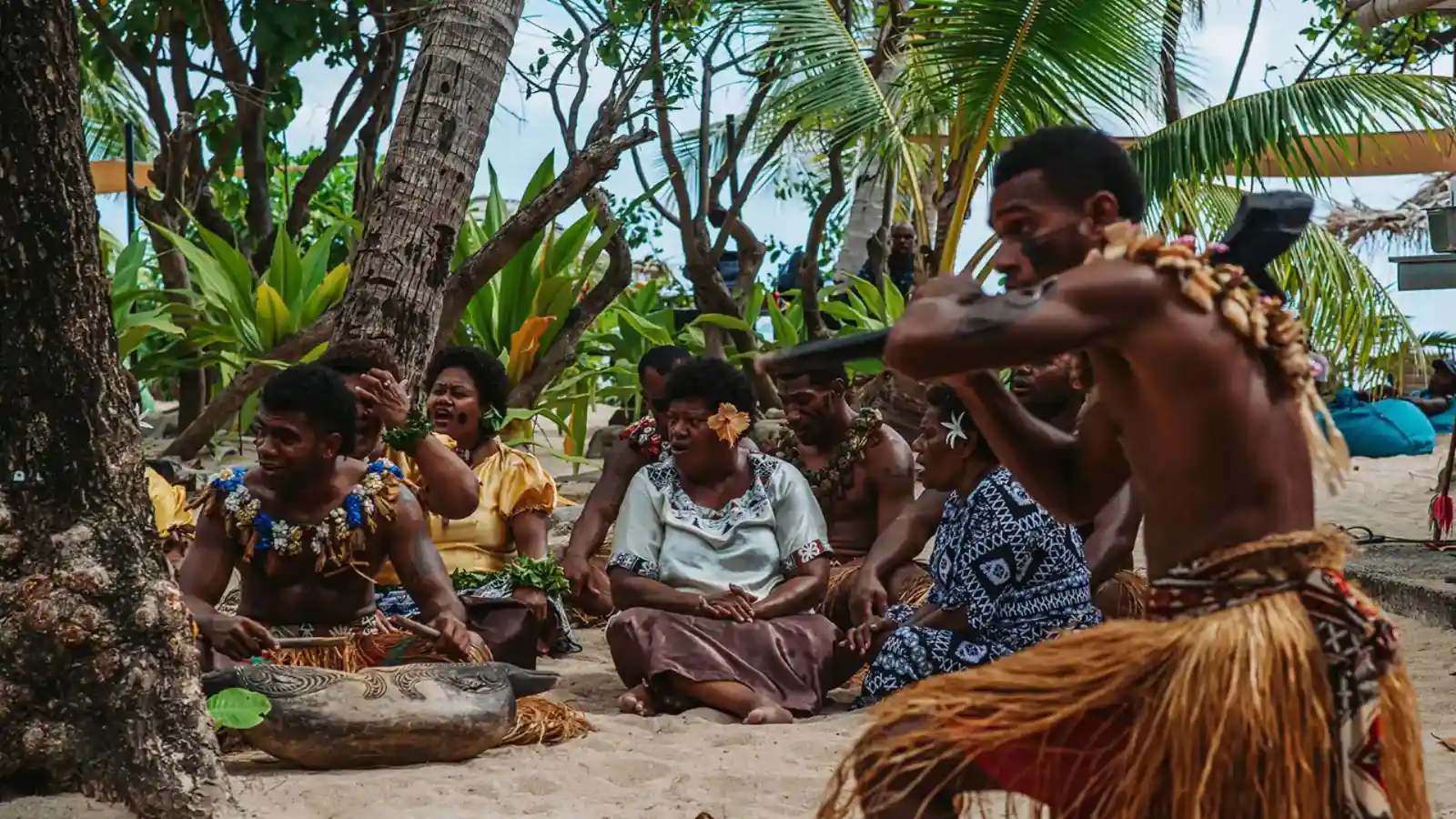
Meke is one of the clearest ways to encounter iTaukei storytelling in Fiji. Voice, rhythm and coordinated movement work together, but there is no single routine called “the meke.” The form, story, dress and setting vary by community and occasion. This guide explains what you are watching, where a traveler can realistically see a performance, what to confirm before paying and how to attend respectfully.
Short answer
Meke is an iTaukei performance tradition that combines sung or chanted text, rhythm and choreographed movement. It may communicate history, genealogy, community memory, celebration or commentary. Travelers most often encounter meke at a booked cultural experience, a resort cultural night or a community event arranged through a host. It is not accurate to label meke itself as a UNESCO-inscribed element.
Meke at a glance
| What it is | A group tradition combining voice, rhythm and coordinated movement |
|---|---|
| What it is not | One standard dance performed identically across Fiji |
| Easiest public option near Nadi | A pre-booked Fiji Culture Village day or night tour |
| Near Suva and the Coral Coast | Check date-specific events at Damodar Arts Village in Pacific Harbour |
| Universal ticket price | None. Prices depend on meals, transfers and the rest of the program |
| Most useful booking question | “Is meke confirmed on my exact date, and what does the price include?” |
What is meke?
Meke is often translated simply as “traditional Fijian dance,” but that description is incomplete. The sung or chanted words, the rhythm and the movements belong together. Tourism Fiji describes meke as a way of telling stories through song and dance, and specialist cultural documentation treats it as part of Fiji’s oral and musical tradition.
A performance can preserve or present community history, relationships, notable events and shared values. The story may be clear to an audience that knows the language and context, while a visitor may first notice the harmonies, gestures and synchronized movement. A good host should explain the occasion and the piece rather than presenting every performance as a generic “war dance.”
Meke is a living tradition, not a museum object. Pieces and performance styles differ by community, island, occasion and group. Visitor presentations may be shorter and include an English introduction, while a community performance can have a different purpose and protocol.
Important UNESCO clarification
Meke should not be described as “UNESCO-listed” or “UNESCO-recognized Intangible Cultural Heritage.” As of this page’s fact-check date, UNESCO’s Fiji country page does not list meke as an inscribed element. UNESCO has documented safeguarding and inventory work in Fiji, including a field survey that recorded vakamalolo, a sitting meke. Documentation or inventorying is not the same as inscription on a UNESCO list.
What you will see and hear
Most visitor-facing performances involve a vocal group, dancers and a clear rhythmic pulse. Singing may be unaccompanied or supported by percussion. A wooden lali slit drum or bamboo derua stamping tubes may appear, but the instruments are not identical at every meke. The safest expectation is voice, rhythm and coordinated movement, not a fixed orchestra.
Tourism descriptions often contrast strong movements in men’s performances with more flowing movements in women’s performances. That is a useful first observation, not a complete classification. Program labels and roles vary, and the local explanation matters more than a universal tourist glossary.
| Term or format | What it can mean | Traveler note |
|---|---|---|
| Men’s or women’s meke | A practical program label for a group or style of movement | Treat the host’s explanation as specific to that performance |
| Vakamalolo | A sitting meke documented in Fiji cultural inventory work | Do not assume every seated item has the same story or function |
| Cibi | A challenge dance widely associated with Fiji rugby | It is not a synonym for every traditional Fijian dance |
| Audience participation | A short invitation to copy simple movements at some visitor shows | This is not automatically a full meke workshop |
Meke, kava, lovo and firewalking are not the same thing
Cultural-night packages may combine several experiences, which can make the terms look interchangeable. They are separate elements and may be offered together or independently.
| Experience | What it is | Booking implication |
|---|---|---|
| Meke | Song, rhythm and coordinated movement | Ask whether a meke performance is confirmed |
| Kava ceremony | A separate welcoming or social ceremony involving yaqona | It may be included, but it is not required before every meke |
| Lovo | Food cooked in an earth oven | Check whether dinner is included in the ticket |
| Firewalking | A distinct tradition associated with Beqa | Do not assume a meke ticket includes firewalking |
Where can travelers see meke in Fiji?
There is no national timetable for meke. Public shows, resort programs and community events work differently. Choose a venue by location and access, then verify the exact date. The table below separates options that can be booked publicly from programs that may be guest-only or event-based.
Current-status check: September 5, 2026. Times and operating days can change.
| Area | Practical option | Access and current status | What to verify |
|---|---|---|---|
| Nadi and Denarau | Fiji Culture Village | Public ticketed experience. The checked listings advertise day tours on Tuesday and Friday, 10:00 to 14:00, and night tours Monday to Saturday, 17:00 to 21:00. | Live date availability, pickup zone, meal and performance inclusions |
| Pacific Harbour, between Suva and the Coral Coast | Damodar Arts Village | The venue advertises cultural performances including meke and Beqa firewalking, but shows are date-specific rather than a dependable daily drop-in. | Live event date, ticket status, separate firewalking component and return transport |
| Suva | Festival, hotel or special-event programming | No recurring public meke show in Suva itself was verified in the official sources checked for this update. | Whether the event is public, the venue, ticketing and late return options |
| Sigatoka and the Coral Coast | Resort cultural programs or a confirmed local event | Schedules vary and many programs are for staying guests. No permanent walk-in “Sigatoka meke workshop” was verified. | Guest-only access, actual workshop content, day-pass rules and transport |
| Mamanucas, Yasawas and other islands | Resort cultural night or a community visit arranged by your host | Convenient if already staying nearby. Community events are not general drop-in attractions. | Operating night, weather changes, visitor access, photography and whether transport is included |
Best choice for a short Nadi stay: a public cultural-village program is easier to verify than hoping a resort or village has a performance that night. Best choice from Suva or the Coral Coast: check a dated Damodar Arts Village performance first, then plan transport around the confirmed finishing time.
How to choose and book a meke experience
The word “cultural experience” can describe anything from a short resort item to a four-hour program with dinner and transfers. Use the same questions for every listing so you know what you are buying.
- Confirm meke on your exact date. A venue can offer meke generally without scheduling it every day.
- Ask for the complete start and finish time. Include pickup, welcome, meal, show and return transfer, not only stage time.
- Check every inclusion. Ask whether the quoted price covers transport, food, kava, meke, firewalking, taxes and booking fees.
- Confirm access. Resort programs can be limited to guests, while community events may require an invitation or an arranged visit.
- Ask about practical needs. Check stairs, seating, toilets, child policy, dietary needs and the walking surface if anyone in your group has limited mobility.
- Save the confirmation offline. Keep the address, contact number, pickup point and cancellation terms available without mobile data.
A message you can send before booking
“Bula. Is a meke performance confirmed on [date]? Is the program public or only for hotel guests? Please confirm the total price, start and finish time, pickup and return transport, meal, kava and firewalking inclusions, and the photo policy.”
How to watch meke respectfully
- Follow the host’s cues. A ticketed stage show and a community occasion do not have identical protocol.
- Ask before photographing or recording. Venue permission and performer consent matter, especially outside a commercial show.
- Dress for the setting. For a village visit, cover shoulders and knees, remove your hat when asked and follow your host’s instructions.
- Participate only when invited. Some shows invite guests for an easy closing dance. Declining politely is fine.
- Do not arrive uninvited at a village. Arrange a visit through a community, accommodation or responsible operator.
- Listen for context. Knowing who created the piece, what it marks and why it is being performed makes the experience more meaningful.
If your program also includes yaqona, read the separate Fiji kava ceremony guide. For a community visit, review village and local-custom guidance. These subjects need their own detail and should not be treated as automatic parts of every meke.
Can travelers join or learn meke?
Sometimes, but “participation” and “workshop” are not the same. A visitor show may invite the audience to copy a few movements at the end. A genuine workshop should name the teacher, duration, learning format and cultural context. Before traveling for one, ask whether it is a scheduled class, a demonstration or a brief audience-participation segment.
For Sigatoka and the Coral Coast, this update did not find an official, permanently scheduled walk-in meke workshop. That does not mean private or resort activities never occur. It means travelers should get written confirmation for their date instead of relying on an undated article.
How to recognize a responsible cultural experience
“Authentic” is often used as a sales label, but it does not tell you who benefits or how the performance is presented. A useful visitor experience can be adapted for an audience and still be respectful. Look for clearer signals:
- Local performers and community participation are identified without turning people into scenery.
- The host explains the piece, setting and limits of what visitors are seeing.
- Price, duration, inclusions, transfers and photography rules are transparent.
- Visitors are not promised access to a private ceremony or village without consent.
- Meke, kava, lovo and firewalking are described accurately rather than blended into one invented ritual.
Plan the rest of the visit
Use the Fiji transport guide to plan the return after an evening show. For more cultural context, compare a structured performance with the Fiji Museum guide or a properly arranged Navala village visit.
Frequently asked questions
What does meke mean in Fiji?
Meke refers to an iTaukei performance tradition in which sung or chanted words, rhythm and coordinated movement work together. It is more precise than treating meke as dance alone, and the content varies by community and occasion.
Where can tourists see a meke in Fiji?
Travelers may see meke at a public cultural venue, a resort cultural night or an arranged community event. Fiji Culture Village near Nadi is a practical public option. Damodar Arts Village in Pacific Harbour has date-specific cultural performances. Always confirm the exact date and access rules before traveling.
Is meke listed by UNESCO?
No UNESCO inscription for meke appears on UNESCO’s Fiji country page as of September 5, 2026. UNESCO has documented Fiji’s cultural inventory work, including vakamalolo, a sitting meke, but documentation is not the same as inscription on a UNESCO list.
Is meke the same as fire dancing or firewalking?
No. Meke combines song, rhythm and movement. Firewalking is a distinct tradition associated with Beqa, and fire dancing is a separate performance format. A cultural-night ticket may include more than one, so check the program details.
Can visitors join a meke?
Some visitor shows invite guests to copy simple movements at the end. Join only when invited and follow the performers. If you want instruction, verify that the product is a scheduled workshop rather than a short audience-participation moment.
Do I need to book a meke performance in advance?
Advance confirmation is strongly recommended. Programs may run only on selected days, require a minimum number of guests or be limited to resort guests. Confirm the date, total price, start and finish time, transfers and inclusions.
What should I wear to a meke?
For a commercial venue or resort, neat casual clothing is usually practical. For a village visit, wear clothing that covers shoulders and knees, remove your hat when asked and follow the guidance of your host.
Sources and verification
Sources checked September 5, 2026. Venue pages remain the final source for your travel date.
- Tourism Fiji: cultural experiences and meke overview
- Tourism Fiji: Fiji Culture Village visitor program
- Fiji Culture Village: current venue information
- Tourism Fiji specialist news: Damodar Arts Village
- UNESCO Intangible Cultural Heritage: Fiji country page
- UNESCO: Fiji field survey and inventorying project
- Ministry of iTaukei Affairs: Cultural Mapping Programme
- Tourism Fiji: village visit etiquette
Found an outdated schedule or a factual error? Email [email protected] with the source so this guide can be corrected.