Great White Wall, Fiji: A Taveuni Dive Guide
Written and researched by Yevhen Derkach
Last updated and fact-checked: .
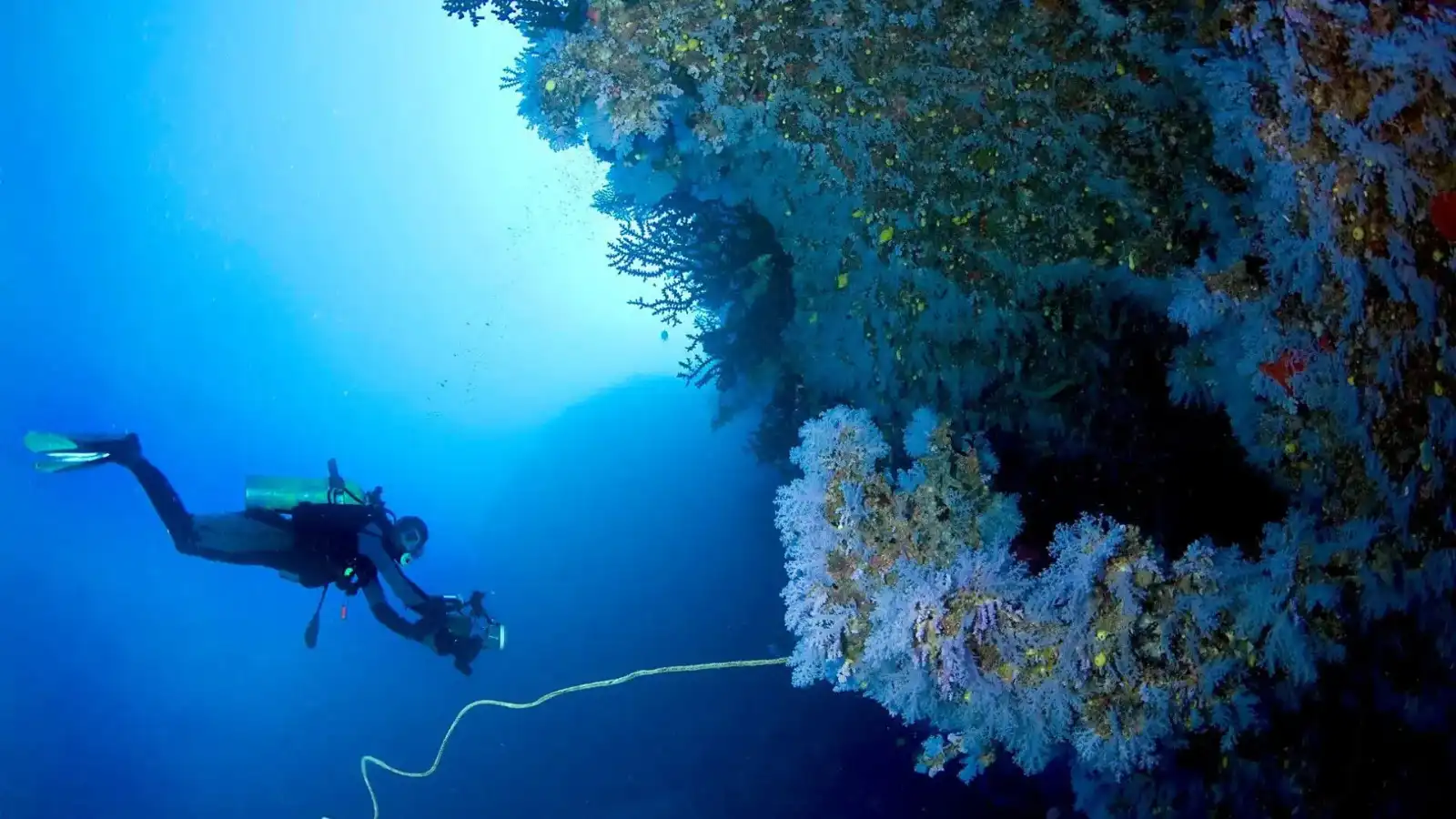
The Great White Wall is a scuba dive site on Rainbow Reef in Fiji’s Somosomo Strait, between Taveuni and Vanua Levu. White soft corals cover a steep underwater wall. You reach it by dive boat, and the most useful planning decision is to match your stay to the operator’s tidal window before booking flights and accommodation.
Where is the Great White Wall in Fiji?
It is part of Rainbow Reef in the channel separating Taveuni from Vanua Levu. Taveuni is a common base, while Viani Bay on Vanua Levu also has direct dive-boat access. The wall is offshore, so arrange a meeting point at the dive shop or shore pickup rather than trying to reach it by road.
The wall’s pale Dendronephthya soft corals feed on particles carried by the current. Their natural white appearance is not coral bleaching. When the colonies expand, the reef face looks very different from the same wall with retracted corals.
Best timing and Great White Wall dive dates
Diving operates year-round in this region. Taveuni Dive Resort describes May through September as a good period for visibility and topside weather. For the Great White Wall itself, the time within the tidal cycle matters more than choosing a season alone.
Operators plan differently. Taveuni Dive Resort’s calendar lists selected days each month. Dive Academy Fiji, based close to the wall in Viani Bay, says it can adjust departure times to find a suitable window on almost any day. These are the operators’ own operating plans, not a single access timetable for the reef.
The following are Taveuni Dive Resort’s remaining planned dates for 2026, reviewed on October 9. Weather, tides and operational conditions can change a planned departure.
| Month | Planned dates |
|---|---|
| October 2026 | 20, 21 |
| November 2026 | 3, 4, 19, 20 |
| December 2026 | 3, 4, 19, 20 |
For a 2027 or 2028 trip, use the same calendar and arrange the date with your chosen operator. Give yourself more than one possible dive day if the wall is the main reason for traveling.
Depth, currents and diver requirements
Dive Academy Fiji describes the densest white coral from around 22 m (72 ft), with much of the main display at 25–30 m (82–98 ft). It offers shallower routes for Open Water divers and deeper routes for suitably qualified divers. Salt Diver recommends experienced divers because of the depth, currents and lava-tube passages.
The guide should set a maximum depth that fits your training and recent experience. Ask whether the route includes a swim-through. Leave deeper sections outside your qualification for a future visit with the appropriate training.
If you have been out of the water for a while, arrange a refresher or an easier reef dive first. Good buoyancy control matters here, especially beside a wall with no nearby bottom reference and around fragile corals.
How to get there and choose your base
From Nadi to Taveuni
Fly to Matei Airport (TVU) on Taveuni. Taveuni Dive Resort describes the Nadi connection as approximately 70 minutes. Book the onward road transfer with your accommodation or dive operator, and use the flight’s actual arrival time when arranging pickup. Compare the domestic flight’s baggage allowance with the weight of your dive gear.
Staying on Taveuni
Salt Diver runs trips from the Matei area. Its check-in point is on the beach below Maravu Resort, beside Dive Coffee. Request accommodation pickup when booking. For Taveuni Island Resort & Spa, Salt Diver lists its check-in point as within walking distance.
Taveuni Dive Resort is another base for diving the strait. Its published FAQ currently limits diving and snorkeling to in-house guests, so arrange a stay-and-dive package rather than assuming you can join as an outside day visitor.
From Taveuni to Viani Bay
Dive Academy Fiji accepts day-trip requests from Taveuni. Its published route uses a road transfer to Wairiki, followed by a boat to Viani Bay. The operator lists roughly 20 minutes by road from the Matei area and 20 minutes by boat. Book both legs together so the pickup fits your dive departure.
From Savusavu or elsewhere on Vanua Levu
Dive Academy Fiji also accepts day-trip requests from Savusavu. Its current dive page describes a road transfer to Waikava, about 1 hour 10 minutes from Savusavu Airport (SVU), then approximately 40 minutes by boat to Viani Bay. This is a road-and-boat outing, with the return journey arranged as part of the booking.
For a stay close to the reef, Viani Bay Resort has boat-only access and meal-inclusive accommodation. Staying at the dive base reduces daily transfers and gives more flexibility around departure times.
Published dive prices and transfer costs
All amounts below are in Fijian dollars (FJ$, or FJD). These are operator dive prices, not a separate admission ticket to the wall. The two offers have different inclusions, so compare the total for the number of dives you want.
| Operator | Published dive rate | Equipment and conditions | Arrange the trip |
|---|---|---|---|
| Salt Diver Taveuni departure | FJ$300 for a two-tank day before 12.5% tax. FJ$337.50 including the published tax. | Gear rental is listed separately at FJ$50 before tax. Ask for the full equipment and pickup quote. | Trip details and rates [email protected] |
| Dive Academy Fiji Viani Bay departure | FJ$210 per guided boat dive on Rainbow Reef, including VAT. | Tanks and weights included. Equipment rental: FJ$15 per piece per day. Minimum two participants. Transfers extra. | Dive prices and transfers [email protected] |
Dive Academy Fiji lists a FJ$280 return boat transfer from Wairiki or FJ$380 from Waikava, for up to four passengers. Its road-transfer examples are FJ$30 each way from the Matei area to Wairiki and FJ$120 each way from SVU to Waikava. Treat the boat figure as a transfer price, not a per-diver charge.
Use the operator’s final written quote for your dates, including equipment, meals, road pickup, return boat transfer and any payment surcharge. Salt Diver publishes rates excluding 12.5% tax; the FRCS VAT guide confirms that rate. For Taveuni Dive Resort, request a package quote for the stay and diving.
What to arrange before the dive day
- Name the dive site: request the Great White Wall specifically and give your available dates.
- Share your experience: send your certification, number of logged dives and date of your last dive.
- Book the complete journey: get the shore meeting point, check-in time and return transfer in the same confirmation.
- Plan for a changed site: ask how the booking works if weather or currents require another Rainbow Reef dive.
For Dive Academy Fiji, use its stay or day-trip request page, email [email protected] or call +679 725 8184.
As one example of the time commitment, Salt Diver’s regular two-dive itinerary runs from an 8:00 AM check-in to roughly 1:30 PM back at the dive shop, with a surface interval between dives. A White Wall departure can follow a different tidal window. Keep the dive day free of tight onward connections.
What to bring and prepare
- Dive documents: certification card or e-card, logbook and insurance details. Save an offline copy of your booking.
- Equipment: your fitted mask and any personal gear you want to use. Arrange a dive computer and surface marker buoy through the operator if you do not carry your own.
- Boat-day essentials: swimwear, towel, a dry change of clothes, drinking water, sun protection and a dry bag.
- Camera: secure it and choose a setup you can manage while maintaining buoyancy. Keep equipment clear of the corals.
Complete the operator’s medical screening before arrival. The 2026 Diver Medical Participant Questionnaire requires a physician’s evaluation for certain flagged answers. Arrange any required clearance before traveling.
This is a remote diving area. Choose insurance that covers your planned scuba activity and emergency evacuation, and ask the operator about onboard oxygen and its emergency plan. During the dive, follow the site briefing, stay with your buddy and keep fins, hands and equipment away from the reef.
Return flights, transfers and onward travel
Set the time of your last dive before booking the flight off the island. DAN’s flying-after-diving guidance recommends a minimum of 12 hours after a single no-decompression dive and 18 hours after multiple no-decompression dives in a day or over multiple days. These recommendations apply to divers without decompression-sickness symptoms. A longer interval further reduces risk. For dives requiring decompression stops, DAN advises an interval substantially longer than 18 hours.
A full non-diving day before departure makes a multi-day dive trip easier to arrange. Tell the operator about your return flight and any planned journey to altitude, and follow a longer restriction if your dive computer or dive professional requires one. If you develop symptoms suggesting decompression sickness, seek medical help and do not fly.
For guests leaving Viani Bay Resort, the property asks for two hours before a TVU flight or three hours before an SVU flight for its transfer. Those allowances cover boat and road travel; they are separate from the interval required after your last dive. For a ferry or another boat connection, arrange the return landing and onward departure together.
Snorkeling and non-diving days nearby
The Great White Wall’s main coral display is a scuba experience. Non-diving companions can book a separate guided snorkeling outing on suitable shallow parts of Rainbow Reef. Taveuni Dive Resort’s guide names Nuku Reef, Fish Factory and Cabbage Patch among its snorkeling sites. The guide chooses a site according to currents and the group.
For a broader reef trip, see our Rainbow Reef guide. On a day away from the dive boat, consider Lavena Beach and the coastal walk. Keep the walk’s transport and exertion in mind when planning it around your diving.
Frequently asked questions
Are the Great White Wall and Rainbow Reef the same place?
The Great White Wall is one dive site within the larger Rainbow Reef area. A Rainbow Reef booking can visit other sites, so name the wall when arranging your trip.
Can I join a dive trip without staying at a dive resort?
Salt Diver offers day trips, and Dive Academy Fiji accepts day-trip requests from Taveuni and Savusavu. Taveuni Dive Resort’s current FAQ restricts its diving and snorkeling to in-house guests.
Can a beginner see the wall?
Ask the operator about a shallower route that fits your certification and recent experience. Some operators offer Open Water routes; others recommend experienced divers. An introductory scuba lesson is not a booking for the deeper white-coral wall.
Sources
Primary sources reviewed on October 9, 2026. Prices and operating plans above are attributed to the operator that publishes them.
- Tourism Fiji: diving in the Somosomo Strait. Location of the strait and its dive sites.
- Dive Academy Fiji: Great White Wall. White soft corals, depth, diver suitability and tidal timing.
- Taveuni Dive Resort: Great White Wall calendar. Operator-specific planned dates for 2026, 2027 and 2028.
- Salt Diver: guided dives. Day-trip itinerary, published FJD rates, tax, equipment and experience requirements.
- Dive Academy Fiji: diving and day trips. Per-dive rates, VAT, minimum group size and transfer prices.
- Dive Academy Fiji: booking a stay or day trip. Requests from Taveuni and Savusavu and individual quotations.
- Viani Bay Resort: arrival and departure information. Boat access, meals, contact details and airport transfer allowances.
- Taveuni Dive Resort: visitor FAQ. Year-round diving, seasonal conditions, airport access and in-house guest policy.
- Taveuni Dive Resort: dive guide. Reef briefings, diving practices and snorkeling alternatives.
- Fiji Revenue and Customs Service: VAT guide. The 12.5% VAT rate effective from August 1, 2025.
- Diver Medical Participant Questionnaire, 2026 version. Medical screening and the answers requiring a physician’s evaluation.
- Divers Alert Network: flying after diving. Minimum preflight intervals and their scope.
Found an outdated detail or an access change? Send FijiEco a correction.