Wreck Diving from Suva: Sites, Prices and Planning
Written and researched by Yevhen Derkach
Last updated and fact-checked: .
For a recreational wreck-diving trip from Suva, start with the operators in Pacific Harbour and their boat trips into Beqa Lagoon. Named sites include Tasu II at Seven Sisters, Carpet Cove and Rusi’s Pinnacle. Choose the wreck and dive profile before booking, then arrange a road transfer around the check-in time. Suva Harbor itself is a working commercial port.
Can you dive wrecks in Suva Harbor?
Fiji Ports describes Suva as a commercial port serving cargo ships, fishing vessels, ferries and cruise liners. For a harbor dive, ask a qualified local operator to identify the site and explain access arrangements and vessel traffic.
In its notice dated May 9, 2026, MSAF reported a 74 m stranded wreck in Suva Harbor’s Lami Bay and requested a wide berth. Treat harbor wreck notices as navigation information. Avoid self-organized dives around moored ships and shipping channels. For named recreational wrecks with published operator descriptions, plan the Pacific Harbour and Beqa Lagoon route below.
Which wreck sites can you visit from Suva?
Tourism Fiji identifies Tasu II at Seven Sisters in Beqa Lagoon as a wreck-diving option. Beqa Adventure Divers’ wreck-site list describes the following three fishing-vessel wrecks. The depths are the operator’s site descriptions; agree on the actual dive profile for your qualifications.
| Wreck | Published depth | Setting | Planning point |
|---|---|---|---|
| Tasu II | About 28 m at the seabed. | An upright, approximately 30 m-long fishing vessel beside the Seven Sisters pinnacles. | The wreck is deeper than an 18 m Open Water qualification. Discuss the profile or further training before booking. |
| Carpet Cove | About 30 m. | A purpose-sunk fishing vessel with nearby coral pinnacles. | A wreck-and-reef combination. Plan maximum depth and bottom time with the guide. |
| Rusi’s Pinnacle | About 32 m at the seabed. | An approximately 40 m-long, two-deck fishing vessel beside a reef pinnacle. | Reaching the seabed exceeds a 30 m qualification. Agree on an appropriate depth and training requirement. |
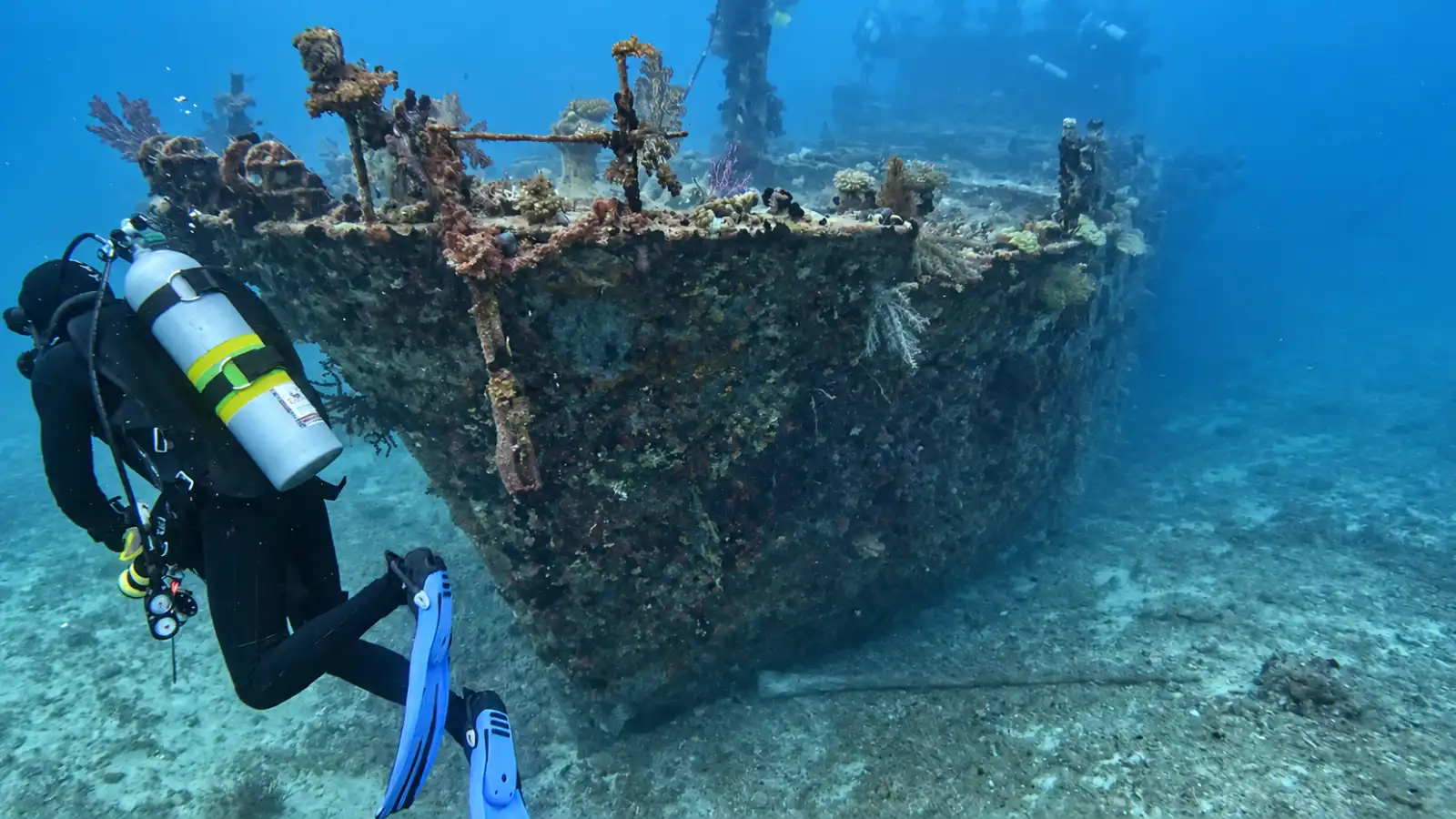
Aqua-Trek also lists Tasu II and Carpet Cove among its Beqa Lagoon sites. Expect wreck structures, coral growth and neighboring reefs, with small marine life worth looking for as well as larger fish. These sites make a good choice if you enjoy slow observation and underwater photography. Keep enough clearance for your fins and camera equipment to avoid touching the wreck or coral.
Wreck-dive operators and booking contacts
Beqa Adventure Divers
Its two-tank soft coral and wreck trip is listed for Wednesday and Sunday mornings, and Monday, Tuesday, Thursday and Friday afternoons. Request the named wreck you want to visit and give the shop your certification, logged dives and recent experience. The published site list includes all three wrecks above.
Meeting point: Fairway Place, Pacific Harbour. Phone, WhatsApp or Viber: +679 998 8006. Use its contact page for an inquiry and the agreed meeting details.
Aqua-Trek
Its two-tank soft coral trips run on Tuesday, Thursday and Sunday. The shop lists Tasu II and Carpet Cove among its sites, so ask whether your date and experience allow a wreck to be included. The advertised morning starts with an 8:00 am check-in and an 8:30 am departure.
Meeting point: The Pearl South Pacific Resort grounds, Queens Road, Pacific Harbour. Phone: +679 702 9898. Email: [email protected]. Its booking office can arrange private road transfers on Viti Levu.
Coral Coast Divers
This operator advertises wreck dives and publishes a separate two-tank soft coral or wreck price. Request the exact wreck, planned depth, check-in time and included sites for your date.
Meeting point: 1 Atoll Place, Pacific Harbour. Phone: +679 291 0167. Use the dive shop’s contact page for booking details. Shark Bait Cafe is at the shop for breakfast or a meal after diving.
Wreck-diving prices and extra costs
These are operator-published base prices for two-tank outings. FJ$ means Fijian dollars; US$ means US dollars. Road transfers and the chosen wreck itinerary need to be agreed separately.
| Operator | Published base price | Gear and other charges | Booking detail |
|---|---|---|---|
| Beqa Adventure Divers | FJ$475 on its dated daily-rates page. Tanks and weights included. | Fuel surcharge FJ$20/day. Full rental gear FJ$50/day. | The FJ$25 reserve levy is listed for diving in Shark Reef Marine Reserve; ask which fees apply to your selected sites. |
| Aqua-Trek | US$155/person for the soft coral outing from April 1, 2026. Tanks and weight belts included. | Full gear hire US$25/person/day. | Request a wreck as part of the trip. Its published shark-dive price is a different product. |
| Coral Coast Divers | FJ$420 or listed online price US$190 for two-tank soft coral or wreck diving. Tanks and weights included. | Full gear FJ$50/day. Card surcharge 3.5%. | The page lists a FJ$25/day marine park fee; only the shark-dive price includes it. |
Beqa Adventure Divers publishes two different prices: its dated daily-rates page lists FJ$475 for soft coral or wreck diving, while the product page lists FJ$450 including VAT. The table uses the dated rate page. Get an itemized quote covering tax, fuel, site fees, gear and your pickup before paying.
Coral Coast Divers’ rates distinguish online payments in USD from dive-center payments in FJD. Use the price for your payment method rather than treating the two amounts as a fixed exchange rate. Private transfers depend on your pickup address, waiting time and return route.
How to get to the dive boat
From central Suva
Travel southwest along Queens Road to Pacific Harbour. Tourism Fiji places Pacific Harbour less than an hour from Suva; allow extra time for city traffic and dive check-in. Give your driver the dive shop’s name and address. The Pearl grounds, Fairway Place and Atoll Place are different meeting points.
For an 8:00 am check-in, arrange an early hotel pickup with the shop or a private driver. Agree on the return pickup at the same time. If you prefer a slower start, stay in Pacific Harbour the previous night.
From Nausori Airport, Nadi or Denarau
Aqua-Trek publishes road estimates of 1.5 hours from Nausori Airport and 2.5 hours from Nadi International Airport. Airport arrival time, baggage collection and check-in are additional. From Denarau, request a quote from your hotel to the named dive shop rather than using the Nadi Airport estimate as your pickup plan. For the journey into the capital, see our guide to getting to Suva.
By public bus
The Suva–Nadi route follows Queens Road through Pacific Harbour. Public buses use Fiji’s eTransport system. Prepare your payment method before boarding and confirm the correct Pacific Harbour stop. Allow time for the walk or local transfer to the shop. For an early dive briefing, an arranged car transfer gives you more control over the arrival time.
You do not need a ferry to Beqa Island for these mainland-operated outings. Your operator’s boat takes you from Pacific Harbour to the dive area. Book island accommodation only if that is part of your broader trip.
Certification, depth limits and wreck safety
Beqa Adventure Divers lists Open Water or equivalent as its minimum entry certification and asks for certification and diving-history checks. That minimum does not extend your depth qualification. PADI’s published training limits are 18 m for Open Water and 30 m for Advanced Open Water, or the maximum reached during the relevant training if shallower. A wreck sitting at 28–32 m requires a dive profile and training suited to that depth.
Tell the shop about your certification, last dive, comfort in current and experience at the proposed depth. With an 18 m qualification, arrange a shallower reef dive or additional training before committing to a deeper wreck. A dive to the 32 m seabed at Rusi’s Pinnacle also goes beyond a 30 m qualification.
External wreck exploration and entering a wreck require different planning. PADI’s wreck-entry guidance considers training, experience, equipment, exits, obstacles and silt. Advanced Open Water alone does not establish wreck-penetration skills. Keep the visit outside unless you have suitable wreck or overhead training and the operator has explicitly planned the entry.
Aqua-Trek accepts Open Water-certified divers aged 12 and older, including junior certifications, on its soft coral trips. Minors must be accompanied by a certified parent or guardian. Junior depth limits still apply to the selected site. Complete the operator’s medical screening in advance; a flagged answer on the 2026 Diver Medical questionnaire can require a physician’s evaluation. Arrange insurance that covers your planned diving and evacuation.
What the dive day looks like and what to pack
Expect check-in, equipment preparation, a boat and site briefing, then two dives with a surface interval. Listen to the plan for depth, gas, the buddy system and getting back to the boat. A reef stop may form part of the outing, so ask how much of the booked trip is intended for wreck diving if that is your priority.
Aqua-Trek’s product page gives a return around 1:00 pm, while its FAQ allows approximately 1:00–1:30 pm. Plan lunch and your road pickup after the later estimate. The exact itinerary for the other operators should come with your booking.
- Certification and logbook: bring your highest qualification and any medical clearance requested by the shop.
- Dive computer: Aqua-Trek says it has no computers for hire. Arrange the equipment you need before arrival.
- Swimwear, towel and dry clothes: add a dry bag and a light layer for the boat ride.
- Exposure protection: choose a wetsuit for the conditions and your comfort over two dives.
- Water and sun protection: ask what refreshments are included and bring what you need for the road trip.
- Payment and booking details: keep your confirmation, pickup address and operator’s phone available offline.
Conditions, seasons and cancellation terms
Wreck availability depends on sea conditions, currents, visibility and the group’s qualifications. Choose your date with the operator and follow its decision if the site changes. The surrounding lagoon does not guarantee a flat boat ride or a fixed visibility range.
Aqua-Trek describes water around 24–27°C in May–October and 27–30°C in November–April. These are regional seasonal ranges, not a forecast for your dive day. The Fiji Meteorological Service marine forecast provides current wind, sea and warning information for Fiji waters.
Read the operator’s cancellation policy before paying and ask how a weather cancellation or replacement reef itinerary is handled. Coral Coast Divers’ policy offers a refund or rescheduling if it cancels the dive day, with card fees excluded in its cancellation terms. Its two-tank day rate does not provide a separate refund if the second dive is canceled. Keep your transport booking’s cancellation terms alongside the dive booking.
Returning to a flight or cruise ship
Flights from Nausori or Nadi
For divers without symptoms after multiple no-decompression dives in a day, Divers Alert Network recommends at least 18 hours before flying. Longer intervals reduce risk further. Give the shop your actual flight time, including domestic flights, and leave a full non-diving day before departure when planning your itinerary. Do not book an afternoon flight after a morning two-tank dive.
For the road transfer, distinguish Nausori Airport from Nadi International Airport and include airport check-in time. Tell the operator about any planned travel to altitude as well. If you develop symptoms suggesting a diving injury, seek medical care and do not fly.
A cruise call in Suva
Give the operator your ship’s arrival time and all-aboard deadline before booking. An 8:00 am dive check-in cannot fit a later disembarkation. A morning boat trip can return around early afternoon, and the drive back to Suva adds more time. Use the ship’s own time standard and arrange the port pickup and return buffer with the operator. An advertised afternoon trip needs its own assessment against the ship’s deadline.
If sharks are your main goal, read our separate Beqa Lagoon shark-diving guide; the sites, prices and schedules differ. For choosing between Fiji’s diving regions, use the Fiji diving comparison guide.
Frequently asked questions
Does a soft coral or wreck booking guarantee a particular wreck?
Request the wreck by name and get the proposed itinerary with your booking. A combined reef and wreck product can include different sites depending on conditions and diver qualifications. Agree on the alternative if the requested wreck cannot be visited.
Can a non-diving partner or snorkeler join the wreck boat?
Aqua-Trek’s FAQ says it cannot accommodate non-divers on its dive boat and that its sites are generally unsuitable for snorkeling because of depth and current. Arrange a separate outing. It directs guests to The Pearl’s tour desk for Beqa Lagoon snorkeling trips.
Can I get underwater photographs without entering a wreck?
Yes. Hull details, coral growth and fish around the wreck offer subjects from outside. Keep your camera and buoyancy under control, leave room for your buddy and follow the guide’s depth and route. Entering the wreck is a separate decision about training and the planned dive.
Sources
Operator information and primary guidance reviewed on October 9, 2026.
- Fiji Ports: Suva port facilities and commercial traffic
- MSAF: May 2026 stranded-wreck warning for Suva Harbor and Lami Bay
- Tourism Fiji: wreck diving in Beqa Lagoon and other Fiji regions
- Beqa Adventure Divers: Tasu II, Rusi’s Pinnacle and Carpet Cove
- Beqa Adventure Divers: 2026 daily rates, scheduled days and extra charges
- Beqa Adventure Divers: two-tank soft coral and wreck product, with a different published price
- Beqa Adventure Divers: certification, experience and safety requirements
- Beqa Adventure Divers: Fairway Place dive shop and contact
- Aqua-Trek: Tasu II and Carpet Cove site descriptions
- Aqua-Trek: soft coral trip, April 2026 price, schedule and minimum age
- Aqua-Trek: equipment, water temperatures, return time and non-divers
- Aqua-Trek: The Pearl meeting point and road transfers
- Coral Coast Divers: wreck-diving offer
- Coral Coast Divers: two-tank wreck price, fees, gear and payment currency
- Coral Coast Divers: cancellation and refund policy
- Coral Coast Divers: Atoll Place address, phone and Shark Bait Cafe
- Tourism Fiji: Pacific Harbour access from Suva
- PADI: training and depth limits for Open Water and Advanced Open Water
- PADI Pros: wreck entry, overhead environments and appropriate training
- Diver Medical Participant Questionnaire, version 2026-01-01
- Divers Alert Network: flying after diving
- Fiji Meteorological Service: live marine forecast and warnings
- Vodafone Fiji: eTransport cards and app QR payments
Found an outdated detail or an access change? Send FijiEco a correction.